


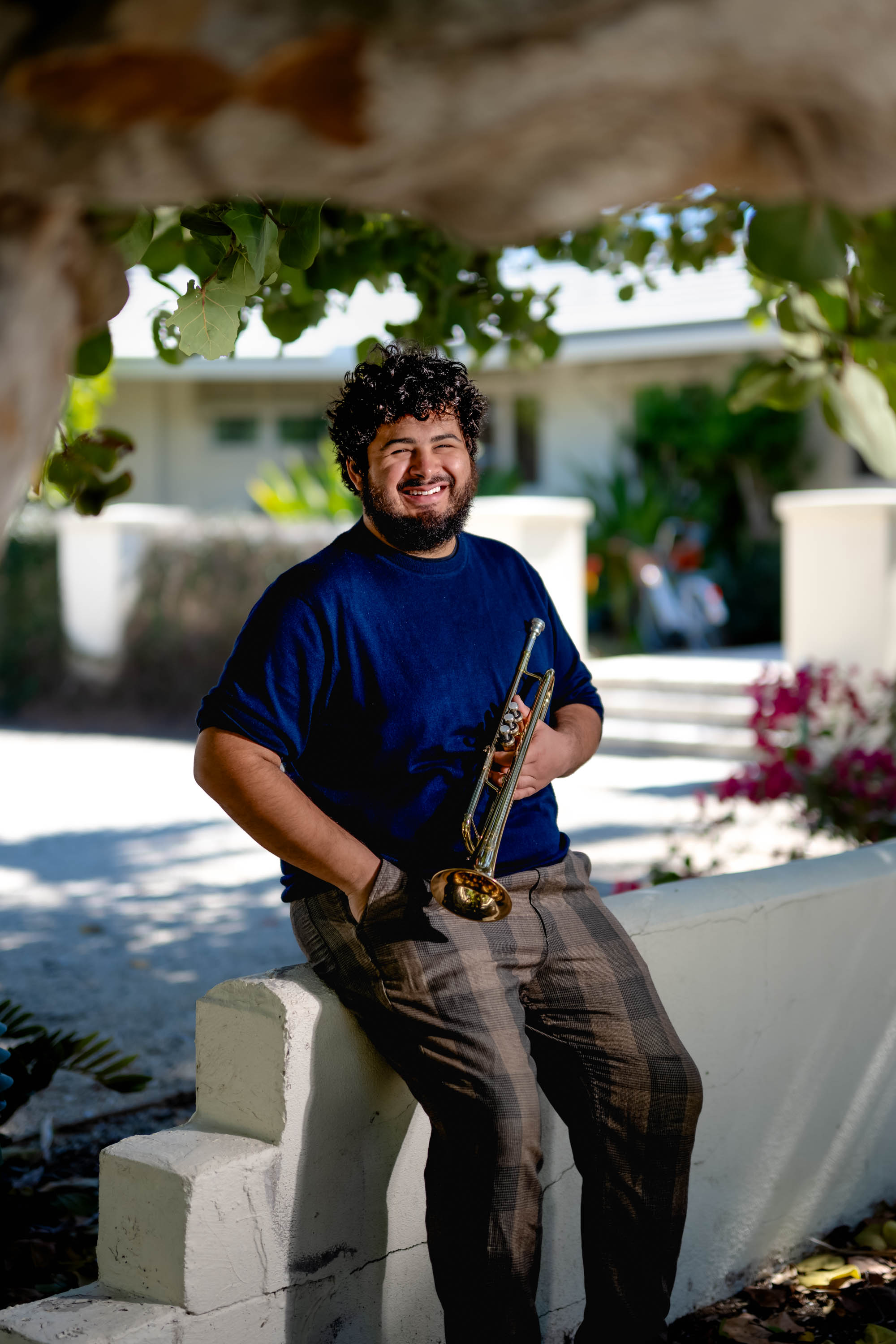
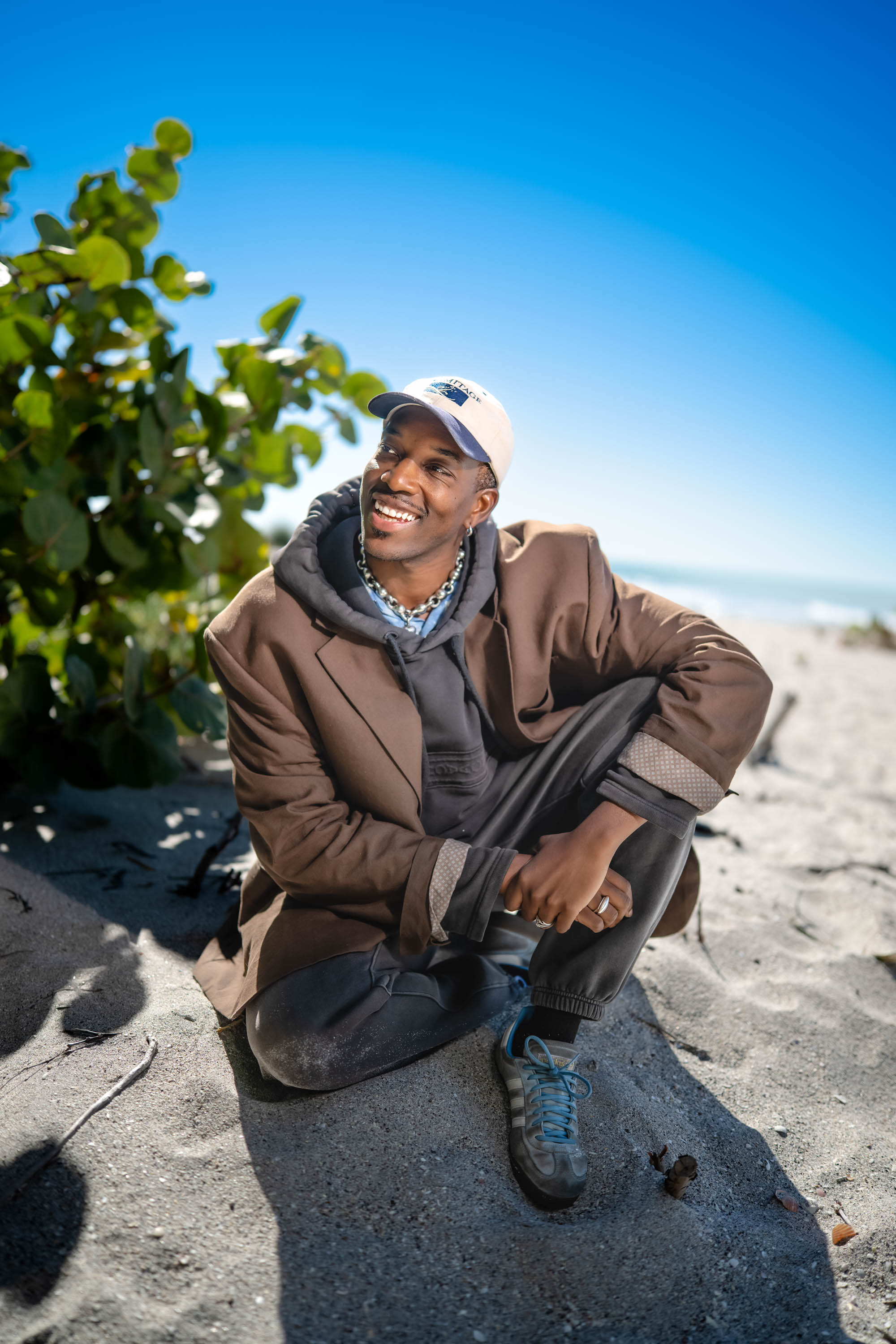
Some things can only happen in Sarasota. On January 29, Adam O’Farrill and Britton Smith took the stage at Marie Selby Botanical Gardens. O’Farrill and Smith are not part of a band—in fact, until just the week prior, the two had never met. O’Farrill is a jazz trumpeter, composer and bandleader, descended from Latin jazz royalty. In the last decade, O’Farrill has established himself as one of the leading voices in contemporary jazz, releasing four albums with his quartet, Stranger Days, and released Elephant on March 20. Smith is another multi-hyphenate, a Tony Award-winning Broadway performer and social activist, Smith is the leader of the funk/soul band Britton and the Sing and released his latest album, Return to MAMA, in early 2026. So what was Smith—a musical artist who operates on the edge of the experimental—doing on the same stage with O’Farrill?
Thank Andy Sandberg, artistic director and CEO of Manasota Key’s Hermitage Artist Retreat. “You have two artists here splitting the bill who just met last week,” says Sandberg. “They’re going to have completely different sets with different approaches to their craft. As an audience member, you’re getting an hour behind the curtain—an artist just being willing to share something, to bare their soul, be it some avant garde wackiness or something that’s going to become a big commercial success. There’s a mutual trust between audience and artists that I think is pretty rare.”
The week prior, Smith had returned for his second residency at the Hermitage, while O’Farrill had arrived for his first. A multi-disciplinary arts incubator, the Hermitage provides a haven for artists across many mediums—Pulitzer Prize, Grammy, Oscar, Tony-award winners and nominees have stayed on the organization’s beachfront campus—come to create, collaborate and develop their craft. The only thing that the Hermitage asks for in return is that each artist participate in a program that gives members of the community an inside look into their work. No critics, no judgement, just an honest expression of who the artist is in that moment. “Ultimately, people that come to Hermitage programs are trusting the brand of its artists trying something,” says Sandberg. “It’s not there to view from a critical lens. Everybody is going to have their own opinion on the work, every program is different.”
Both Smith and O’Farrill came to the Hermitage at inflection points in their respective careers. Both younger artists in their thirties, the two have established themselves enough to where their names mean something. Now, it’s a matter of figuring out what their work means to them and what they want to be known for as artists. They are two sides of the same artistic coin, musical artists working in differing mediums, driven by the same creative force, brought together by the unique mission of the Hermitage.
For Smith, working on a project centered around the connection between queer Black men and their grandmothers, art is the looking glass through which he finds his identity. Writing music is how Smith reconciles with familial history and the pieces of his past—his time spent at the Hermitage allows him to reach deeper within himself. “I’m so blessed to pause in such a beautiful environment to create, reflect and process. It feels like there’s also this ghost of music that is always trying to tell me something, to whisper the truth to me,” says Smith. “There’s a lot of aggression inside of me that is trying to whisper to me and say, ‘write about that brother. You’ve been given time and paradise and sunlight.’ You’ve been given an opportunity to unpack the truth and I’m grateful that this ghost of creation has continued to push me to places like the Hermitage.”
O’Farrill also used the tranquil beachfront campus as an opportunity to reflect on a whirlwind decade of performing, touring and writing music. The grandson of heralded Cuban composer Chico and son of composer, pianist and activist Arturo, O’Farrill has honored his rich artistic heritage by creating his own unique identity within contemporary jazz. His residency at the Hermitage gave him a minute to breathe. “I’ve been touring for over ten years and have always written music at the same time,” says O’Farrill. “To be here just to write feels clarifying for how I want to move forward in my career. I love what my artistic life has been up to this point. I’ve collaborated with a lot of amazing artists over the past decade or so and I’ve learned so much from them. It’s great to be able to take those lessons and apply them to my own writing and not be distracted by anything else.”
Smith and O’Farrill’s performance at Selby Gardens provided further insight into another aspect of their work—the relationship between performer and audience. While leaving room for spontaneity and improvisation is an aspect of both Smith and O’Farrill’s performance styles, the two differ in how they want audiences to receive their music. For O’Farrill, a work isn’t complete until it’s in front of an audience—when on stage, the audience is bearing witness to a world that he’s created. “I try to close my eyes and not take any reaction personally. I try to trust that I am doing this thing, some people are going to love it, some won’t get it and some might hate it,” says O’Farrill. Smith, who comes from a church background, operates more like a “mean pastor” when on stage. “I’m on the flip side of that. I want you to put your hands together right now and clap with me,” says Smith. “If you’re willing to clap with me, you’ll be more willing to have a good time. I like to create an environment where the willingness is contagious, which brings me so much joy, because then it’s not about my songs nor is it about me performing. It’s about me inviting others to feel close to each other.”
Working in proximity to O’Farrill, however, has allowed Smith to take some cues from his creative counterpart. “What Adam said about closing your eyes and going away during a performance is actually something that I’m working on. There’s a level of faith and trust that Adam has in his process—I want to be able to trust that the audience is clapping or engaging with the music,” says Smith. “It’s great to be in a space with other artists who have a different approach, because it reminds you that, ‘oh this is possible. I’m kind of into that and I want to lean into that a little bit more in my work.’”